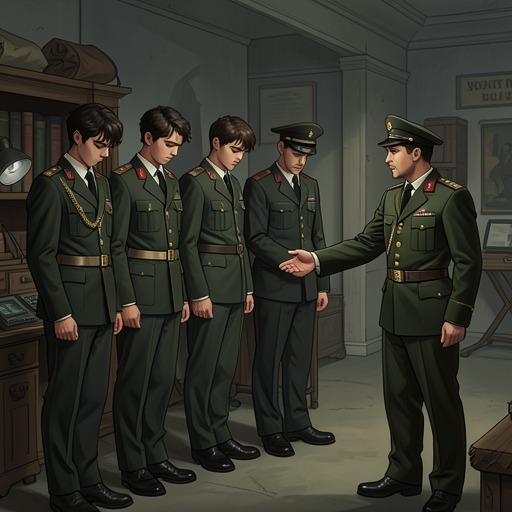
Julius Stoddard’s flight from West Point
The Pale Blue EyeJulius Stoddard’s flight from West Point transforms a cadet’s unexplained disappearance into a documented escape. When Captain Hitchcock announces that another cadet has vanished, Augustus Landor reads the empty space in Stoddard’s trunk as evidence that he left alive; a fisherman’s account soon traces his journey downriver, out of uniform, and onward toward New York. The escape changes the immediate stakes of the investigation, but Stoddard’s hurried departure, unexplained crisis at home, and visible shivering leave its deeper circumstances uncertain.
Discovery and the change in the investigation
Captain Hitchcock breaks the news in Edgar Allan Poe’s hearing, setting aside the usual decorum of their dealings to announce that a cadet has vanished. Poe asks which one; Hitchcock names Stoddard. Landor’s response is initially disbelief, but the announcement establishes that the disappearance is not a rumor and that the investigation has acquired a new problem. The presence of Poe matters to the scene: Hitchcock could have dismissed him, yet gives the news openly, while Landor registers that something in the commandant’s customary reserve has changed.
The possibility that Stoddard is another corpse is raised by the circumstances of a missing cadet, but Landor points out that the trunk contained no civilian clothes. Rather than treating this absence as proof of death, he reads it as evidence that Stoddard may have left in his uniform and taken no change of clothing with him. He concludes that the investigators probably do not have another body to find and that Stoddard has run away on his own. This is an inference, not yet a confirmed account: its force comes from turning a troubling absence into a testable possibility.
Landor also recalls that Stoddard was the only cadet petitioning to cancel the term. That detail gives the flight a particular context. Stoddard was not merely one of several students known to be seeking leave; he had already made a formal attempt to end his term. The petition does not explain why he left abruptly, but it makes the possibility of a planned departure more credible and gives the investigators a reason to consider flight rather than another killing.
The route away from West Point
The next morning, a local fisherman, Ambrose Pike, comes forward with an account that supports Landor’s reading. A young cadet flagged Pike down and offered him a dollar to row him downriver. Pike carried him as far as Peekskill. There, the young man took another couple of dollars from a leather pouch and booked passage on the next steamer to New York. The account establishes a sequence of practical steps: a paid boat ride away from the Academy, a transfer at Peekskill, and onward travel by steamer. Stoddard is no longer simply missing from West Point; he has been seen arranging his way out of the region.
His disguise is gradual rather than complete from the outset. Pike recognizes his passenger as a cadet because the young man is still wearing his uniform during the journey downriver. Only after they reach Peekskill does he put on a homespun shirt, neckerchief, and fur cap, becoming, in Pike’s description, indistinguishable from an ordinary river rustic. The uniform that first identifies him thus becomes clothing to discard once he has reached a point where changing can help him travel without appearing to be a military student.
The departure is also marked by the haste with which Stoddard moves between stages. He does not wait for the Academy longboat, and his trip with Pike ends at Peekskill rather than at his final destination. The additional payment for the steamer carries him farther from West Point. These details make the escape concrete without establishing how he arranged it in advance or whether anyone assisted him beyond Pike’s unwitting transportation.
Stoddard’s explanation and physical condition
Asked why he was leaving so quickly, Stoddard reportedly told Pike that there was a crisis back home and that he could not wait for the Academy longboat. He offered no further explanation, including after they reached Peekskill, and did not say farewell. The crisis is therefore part of the account Stoddard gave to his ferryman, not a verified explanation of his motives. His silence leaves open whether the claim was true, incomplete, or simply intended to hasten his journey.
Pike remembers Stoddard as very pale. Although the sun was strong and the young man was heavily bundled, he repeatedly broke into shivers. Those details complicate the apparent competence of the escape: Stoddard can pay for successive legs of travel and change his appearance, yet his condition seems conspicuously poor. Pike cannot say what the shivering meant, and the narrative supplies no definite cause. It remains an observation, not evidence that Stoddard was ill, frightened, or pursued.
Pike himself comes forward because his wife warns him that the cadet might be a fugitive and that transporting one could expose him to prosecution for aiding a criminal. He says he wants it understood that he is no abettor. His testimony is consequently both useful and self-protective: he supplies the route, clothing change, explanation, and physical description while making clear why he has decided to report what he saw.
Consequences and narrative significance
Pike’s testimony confirms the central distinction in Landor’s early assessment: Stoddard has disappeared from the Academy, but the available evidence points to a living fugitive rather than a newly discovered victim. That does not resolve every question raised by the disappearance. The account identifies a route to New York and a stated reason for leaving, but neither confirms what the crisis at home was nor reveals Stoddard’s intentions beyond getting away. His destination is known only as the next steamer’s destination; his subsequent circumstances are not established here.
The episode also shows how the investigation advances through small, concrete clues rather than certainty. An empty supply of civilian clothes first gives Landor grounds to suspect a voluntary departure; Stoddard’s petition to cancel the term supports that reading; Pike’s testimony then supplies a route and a witness. The shivering and pallor resist such a neat resolution, adding an unexplained note to an otherwise practical account of escape. Stoddard’s flight narrows one question—whether his disappearance means another body—while preserving the more difficult question of why he left with such haste.